
Segmenting Freight Shipments Across North America: When the Direct Route Isn’t the Best Route
The obvious answer may be to find one freight solution that takes it directly from origin to destination. Depending on the shipment, however, the most efficient approach may be very different.
At Wood-Hall Logistics, we regularly look beyond the direct route when helping customers solve longer or more complex freight lanes. Segmenting a shipment into strategic stages can create opportunities for consolidation, better carrier access and more competitive transportation options without necessarily extending the overall delivery schedule.
For longer cross-country and cross-border freight, Ontario can play an important role as a strategic connection point, particularly on east-west lanes.
What Does Segmenting a Freight Shipment Mean?
Consider freight moving from Alberta to New York State.
Instead of looking only for an Alberta-to-New-York solution, the shipment might move:
Northern Alberta → Ontario → Syracuse, New York
The first leg brings the freight into Ontario, where it can be cross-docked, consolidated or transferred. A second carrier or service then moves it into the Eastern U.S.
The freight still reaches the same destination. The difference is how the transportation network is being used.
Why Can Segmenting Reduce Freight Costs?
Carrier availability, equipment, lane balance, shipment size, regional density and where carriers need their equipment next can all affect the rate.
This becomes especially important when the shipment is less than a full truckload. Finding one carrier willing to dedicate capacity to a long, irregular lane may be more expensive than connecting transportation services in markets where capacity is more readily available.
• Consolidate compatible freight
• Access stronger regional carrier networks
• Match different equipment or service levels to each leg
• Use LTL strategically instead of paying for unused truck capacity
• Cross-dock freight without committing to long-term storage
• Build more options into difficult or underserved lanes
The objective is not to add unnecessary touches. It is to determine whether breaking the shipment at the right location creates a better overall transportation plan.
Why Ontario Can Be an Effective Connection Point
That position is especially relevant for shipments travelling between Western Canada and Eastern U.S. markets such as New York, Pennsylvania and New England. While this article uses west-to-east freight as the example, the same segmented approach can also work in reverse, with freight moving from the Eastern U.S. through Ontario before continuing west across Canada.
The scale of Canada-U.S. truck freight reinforces the importance of these corridors. In 2025, trucks carried approximately US$396.8 billion of freight between Canada and the United States. Detroit, Port Huron and Buffalo-Niagara Falls were the three largest Canada-U.S. truck border gateways by value, collectively accounting for more than 60% of truck trade.
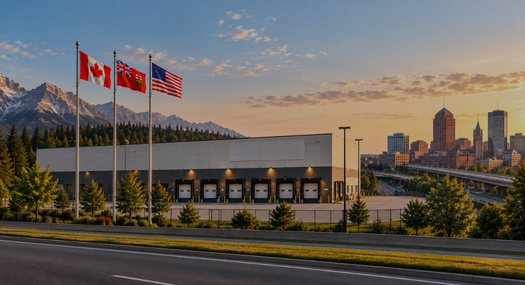
Wood-Hall’s location and experience in Ontario allow our team to look at these connections differently. Freight moving east or west can potentially be brought into Ontario, cross-docked or consolidated, and then matched with transportation better suited to its final eastern destination.
Does Segmenting Make Sense for Every Shipment?
A full truckload moving from origin directly to destination may already have an efficient transportation plan. High-value, highly sensitive or extremely time-critical freight may also benefit from minimizing transfers.
• Freight does not fill an entire trailer
• A direct lane has limited or expensive capacity
• Multiple shipments are moving toward similar destinations
• Freight needs to be separated for different customers
• Regional carriers provide stronger options for the final leg
• A cross-dock can connect long-haul and regional transportation efficiently
Timing matters as well. A segmented solution is only valuable if the handoff, cross-dock and onward transportation are coordinated properly.
The Best Route Is the One That Solves the Whole Shipment
At Wood-Hall Logistics, our experience with LTL, truckload, Canada-U.S. cross-border freight, cross-docking and consolidation helps us evaluate the complete journey rather than simply pricing Point A to Point B.
Sometimes the best solution is direct.
Other times, strategically segmenting the shipment can provide better access to capacity, improve flexibility and lower the total transportation cost while still meeting the required delivery timeline.
That is the value of looking at freight as a network rather than a single lane.
Have a Difficult Long-Distance Lane?
Tell us what you need to move, and we’ll help you build the right plan.
Planning an Upcoming Shipment?
Need help determining a realistic transit time or the right transportation solution?
Connect with Wood-Hall Logistics to discuss your next shipment or request a quote.
About Us
Wood-Hall Logistics is a full-service logistics and freight management company, offering a range of transportation solutions, based on the customer's specific needs. Built on our reputation within the transportation industry and our network of quality carriers, Wood-Hall Logistics ensures that all shipments are handled with utmost care. Ship with us today!

Main Menu
Contact US
280 Woolwich Street S, Unit 206
Breslau, Ontario N0B 1M0
Hours of Operations
Available 24/7
Monday - Friday
7 am - 6 pm
Shipping Hours:
8 am - 4 pm